


The Lexington Opera House (1887) - Lexington, KY
← Resources ← Types of OCD ← Real Event & False Memory OCD
Real Event OCD and False Memory OCD: When You Can't Stop Questioning the Past
Most forms of OCD seem to ask questions about the future: "What if something bad happens?"
Real Event OCD and False Memory OCD often turn that same uncertainty toward the past.
-
"What if I did something terrible?"
-
"What if I'm remembering it incorrectly?"
-
"What if there's an important detail I'm forgetting?"
-
"What if this thought is actually a memory?"
-
"What if what happened says something terrible about me?"
Instead of worrying primarily about what might happen, someone can become trapped trying to determine exactly what did happen, what it means, or whether they can ever feel completely certain about it.
The memories, events, and questions may be different from person to person. But OCD's demand is remarkably consistent: Figure this out before you're allowed to move forward.
Our therapists in Louisville use Exposure and Response Prevention (ERP) to treat Real Event, False Memory, and Stuck Thoughts OCD, as well as all other OCD subtypes.
What Are Real Event OCD and False Memory OCD?
Real Event OCD and False Memory OCD aren't separate diagnoses. They're terms commonly used to describe OCD presentations involving persistent doubt, guilt, uncertainty, and compulsive attempts to understand or reconstruct the past.
The two can look very similar.
The primary difference is usually where the uncertainty begins.
What Is Real Event OCD?
Real Event OCD involves becoming obsessively preoccupied with something that actually happened.
The event may involve:
-
A mistake
-
An embarrassing moment
-
A questionable decision
-
Something that feels morally uncomfortable
-
A conflict or interaction with another person
-
Something said or done years ago
-
A situation that wasn't handled perfectly
The question usually isn't: "Did this happen?" The person already knows that something happened.
Instead, OCD begins asking:
-
"What does this say about me?"
-
"Did I handle it correctly?"
-
"What if my intentions were worse than I remember?"
-
"Was what I did unforgivable?"
-
"Am I a bad person because of it?"
-
"What if I'm minimizing what happened?"
-
"What if there's something important I'm forgetting?"
A person may spend enormous amounts of time trying to determine exactly what happened, why it happened, what they were thinking at the time, and what the event ultimately says about them. That being said, every conclusion seems to generate another question.
What Is False Memory OCD?
False Memory OCD shifts the uncertainty slightly.
Instead of becoming preoccupied primarily with the meaning of an event known to have occurred, someone becomes consumed by uncertainty about whether something happened at all, or whether they remember it accurately.
Questions might include:
-
"What if I hit someone with my car and didn't realize it?"
-
"What if I said something offensive and forgot?"
-
"What if I cheated on my partner but can't remember?"
-
"What if I hurt someone?"
-
"What if I did something terrible when I was drinking?"
-
"What if this image in my head is actually a memory?"
The experience can feel incredibly convincing.
Someone may think: "Why would I be able to picture it if it didn't happen?" or "Why does this feel familiar?"
OCD can treat the feeling of familiarity, vividness, or emotional intensity as though it were evidence.
The person then begins investigating the memory in an attempt to finally determine what is real.

What's the Difference Between Real Event OCD and False Memory OCD?
A simple way of thinking about the distinction is:
Real Event OCD: "I know something happened, but I need certainty about exactly what happened and what it means."
False Memory OCD: "I'm not certain whether something happened, and I need to figure out whether this is a real memory."
In practice, the two frequently overlap.
Someone may begin with a real event and then become uncertain about particular details.
-
"Did I say that?"
-
"Was that really my intention?"
-
"Did something else happen that I don't remember?"
Likewise, someone experiencing False Memory OCD may eventually become convinced that something probably happened and begin obsessing over what it means about their character.
Both can eventually arrive at the same demand: "I need certainty about the past before I can move forward."

Common Real Event and False Memory OCD Obsessions
Common obsessive questions may include:
-
What if what I did was unforgivable?
-
What if I'm remembering the event incorrectly?
-
What if I left out an important detail?
-
What if my memory has changed over time?
-
What if my intentions were actually terrible?
-
What if I'm minimizing what happened?
-
What if an image in my mind is a real memory?
-
What if I hurt someone and forgot?
-
What if other people would judge me if they knew?
-
What if I should confess?
-
What if I haven't taken enough responsibility?
-
What if the fact that I feel guilty means I actually did something wrong?
-
What if I can never know exactly what happened?
-
What if I don't deserve to move on until I figure this out?
These questions can feel morally important, emotionally urgent, and extremely difficult to leave unanswered.
That's part of what makes these OCD themes so sticky.
Common Real Event and False Memory OCD Compulsions
Compulsions in Real Event and False Memory OCD are often mental and therefore easy to overlook. They may include:
-
Replaying memories repeatedly
-
Reconstructing timelines
-
Reviewing conversations
-
Searching for missing details
-
Checking old texts, emails, photographs, or social media
-
Asking other people what they remember
-
Comparing different versions of a memory
-
Checking emotional reactiona to determine what "really" happened
-
Analyzing one's intentions
-
Confessing or repeatedly disclosing the event
-
Retelling the story to see how it sounds
-
Seeking reassurance that one isn't a bad person
-
Googling laws, morality questions, or similar situations
-
Comparing one's behavior with what others have done
-
Mentally checking whether a memory feels real
-
Trying to create a complete account of an event
These behaviors can feel like responsible investigation. But when they become compulsive, every answer creates another reason to keep investigating.
The Rumination Trap
Rumination is one of the most common compulsions in Real Event and False Memory OCD.
Someone may spend hours replaying an event:
-
"What exactly happened?"
-
"What did I say first?"
-
"What happened immediately afterward?"
-
"What was I thinking?"
-
"How did the other person respond?"
-
"Why can't I remember that part clearly?"
For a moment, the person may reach a conclusion: "Okay. I think I finally understand what happened."
Then OCD notices something else: "Wait. What about this detail?"
And the investigation begins again.
OCD treats every answer as incomplete.
It promises certainty if you just analyze a little longer, remember a little harder, or find one more piece of evidence. But the finish line keeps moving.
When Rumination Feels Like Responsible Problem-Solving
Real Event OCD can be especially difficult because rumination often feels responsible.
Someone may think:
-
"I shouldn't just let this go if I actually did something wrong."
-
"I'm not ruminating. I'm trying to understand what happened."
-
"Wouldn't a good person want to make sure?"
-
"If I stop thinking about it, maybe I'm avoiding responsibility."
And sometimes reflection on past behavior is appropriate.
People make mistakes. We can acknowledge them, apologize when appropriate, learn from them, make repairs when possible, and choose differently in the future. OCD asks for something different. It asks for a level of investigation that never seems complete.
There is always another motive to examine. Another detail to reconstruct. Another possibility to consider. Another way the event could be interpreted.
Healthy reflection can inform what we do next. Compulsive rumination keeps demanding a final verdict before we're allowed to move on to what's next.
Why Memory Doesn't Provide the Certainty OCD Wants
Human memory isn't a perfect recording of the past. We forget details. We remember some parts of experiences more clearly than others.
Memories can feel vivid or vague. We may remember the general sequence of an event while being uncertain about exactly what was said, what we were thinking, or how something happened.
Usually, we tolerate those imperfections without much difficulty.
OCD treats them as a problem:
-
"Why can't I remember that part?"
-
"If I'm uncertain, maybe something happened."
-
"Why does this image feel familiar?"
-
"What if I've remembered it wrong all these years?"
The natural response is to review the memory; however, repeated review can create another problem.
After mentally reconstructing an event dozens or hundreds of times, someone may begin wondering: "Do I actually remember that happening, or do I remember imagining it during all the times I've reviewed it?"
Then the attempt to create certainty about memory produces even more uncertainty about memory.
Treatment isn't about proving which memories are accurate and which aren't. That would simply turn therapy into another investigation. The challenge is learning to live with the reality that memory cannot provide the absolute certainty OCD is demanding.

Why You Can't Think Your Way to Perfect Certainty
Logic isn't inherently bad for OCD. The problem occurs when logic becomes another tool for obtaining certainty.
Someone might tell themselves: "There's no evidence I did anything wrong."
That helps briefly; however, the absence of evidence isn't proof. Then we develop another argument: "I'm not the kind of person who would do that."
OCD responds: "But what if you were different back then?"
Another argument. Another counterargument. Another hour gone.
At that point, the goal is no longer thoughtful reasoning. The goal has become feeling certain.
When logic is repeatedly used to disprove an obsession or eliminate uncertainty, it can function like any other compulsion: temporary relief followed by another doubt.
OCD is extraordinarily good at producing another: "Yeah, but what if...?"
Recovery involves learning that you don't have to win that debate. Sometimes the most useful response to an unanswerable question isn't a better answer. It's becoming less willing to spend your life answering it.

When OCD Gets "Stuck" on a Thought
Sometimes OCD becomes attached to something that has little or nothing to do with a past event, such as words, numbers images, phrases, song lyrics or melodies, or even a strange idea.
The person becomes hyperaware of the thought and begins worrying:
-
"What if I think about this forever?"
-
"What if this gets permanently stuck in my head?"
-
"What if I can never stop noticing it?"
Then they begin checking: "Am I still thinking about it?"
Of course, checking whether you're thinking about something requires thinking about it.
The person may try to suppress the thought, distract themselves, replace it with another thought, or monitor how frequently it occurs. Ironically, all that attention can make the thought seem increasingly sticky.
The issue isn't necessarily that the thought itself is unusually important. It's that OCD has convinced the person to keep checking whether it's still there.
Treatment follows a familiar principle:
The goal isn't forcing the thought out of awareness. It's becoming less organized around whether the thought happens to be present.
ACT-Enhanced ERP for Real Event and False Memory OCD
Exposure and Response Prevention (ERP) is a first-line psychological treatment for OCD.
At River City OCD Clinic, we integrate ERP with principles from Acceptance and Commitment Therapy (ACT).
Rather than trying to prove that a memory is accurate, disprove a feared interpretation, or achieve perfect certainty about the past, ACT-enhanced ERP helps people develop greater willingness to experience doubt while reducing the compulsive behaviors used to resolve it.
The goal shifts from: "How do I finally figure this out?" to "How do I want to live while uncertainty remains?"
ERP: Practicing Uncertainty About the Past
ERP for Real Event and False Memory OCD may involve intentionally approaching reminders, memories, thoughts, or uncertainty that someone has been avoiding.
Depending on the person, that might include:
-
Looking at a reminder of an event without analyzing it
-
Allowing a memory to remain incomplete
-
Reading an old message without reconstructing the entire interaction
-
Allowing uncertainty about one's intentions
-
Encountering a trigger without checking whether it creates a "memory"
-
Practicing statements that leave room for uncertainty
-
Returning to valued activities while questions remain unanswered
Someone might practice allowing: "Maybe I remember everything accurately, and maybe I don't" or "Maybe there's something I'm missing, and maybe there's not."
But uncertainty statements aren't magic phrases to repeat until anxiety decreases. If someone repeats "maybe, maybe not" 47 times until they finally feel better, OCD has simply acquired a new ritual.
The purpose is to stop participating in the demand for a verdict, not to find a more sophisticated way of reassuring ourselves.
Response Prevention: Stepping Out of the Investigation
For Real Event and False Memory OCD, response prevention often means learning not to reopen the investigation every time doubt appears.
That may involve:
-
Resisting repeated memory review
-
Not reconstructing timelines
-
Reducing reassurance seeking
-
Resisting repeated confession
-
Not checking old texts, photos, or emails
-
Reducing online research
-
Allowing uncertainty about motives or intentions
-
Not asking other people repeatedly what they remember
-
Resisting attempts to determine whether a mental image "feels like" a real memory
-
Choosing not to analyze the event again simply because anxiety returned
This doesn't mean someone is prohibited from ever thinking about the past. The distinction is whether reflection serves a useful purpose, or whether OCD is demanding another round of investigation in pursuit of certainty.
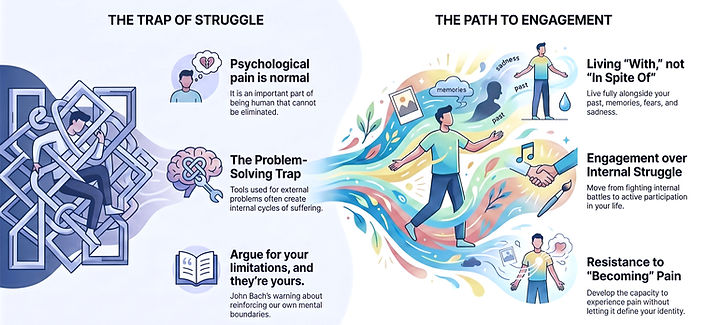
Mindfulness can help people notice when the mind has returned to the courtroom.
-
"There's the memory again."
-
"There's guilt."
-
"There's the urge to figure it out."
-
"There's my mind asking for another review."
The goal isn't to make those experiences disappear. It's to notice them without automatically treating them as instructions.
Acceptance involves making room for:
-
Doubt
-
Guilt
-
Frustration
-
Uncertainty
-
Incomplete memories
-
Unanswered questions
-
The possibility that complete resolution may never arrive
Acceptance doesn't mean deciding that a feared interpretation is true. It also doesn't mean approving of everything you've ever done. It means recognizing that you don't have to completely resolve every internal experience before deciding what to do next.
Mindfulness and Acceptance
Moving Forward Without a Final Verdict
Eventually, Real Event and False Memory OCD bring people to a particularly difficult question: "What if I never figure it out?"
OCD desperately wants a reassuring answer...
-
"Don't worry. You'll eventually remember."
-
"I'm sure nothing happened."
-
"You're definitely a good person."
Those answers may feel good temporarily, and yet ACT-enhanced ERP offers something different:
-
"Maybe I won't ever remember every detail, or maybe I will."
-
"Maybe some uncertainty will remain, or maybe it won't."
-
"Maybe I won't get the perfectly satisfying conclusion OCD keeps promising me, or maybe I will."
And despite that uncertainty:
Life can still move forward, relationships can still matter, values can still guide decisions, someone can apologize when an apology is appropriate, they can learn from genuine mistakes, they can make different choices today, and they can become the kind of person they want to be without first completing a flawless reconstruction of who they were yesterday.
The goal isn't having a perfect memory. The goal is freedom from compulsive certainty-seeking.

Frequently Asked Questions About Real Event and False Memory OCD
What is Real Event OCD?
Real Event OCD describes an OCD presentation in which someone becomes obsessively preoccupied with something that actually happened and repeatedly questions what occurred, what it means, whether they handled it correctly, or what it says about them.
The problem isn't simply remembering a mistake or regretting something.
The OCD cycle develops when the person becomes trapped in repeated rumination, checking, reassurance seeking, confession, or other attempts to achieve certainty and emotional resolution.
What is False Memory OCD?
False Memory OCD involves obsessive doubt about whether something happened or whether a memory is accurate.
Someone may experience a mental image, vague recollection, feeling of familiarity, or simply an intrusive possibility and begin investigating whether it represents a real event.
The search for certainty can then involve repeated memory checking, reviewing evidence, asking other people what they remember, or mentally reconstructing events.
What's the difference between Real Event OCD and False Memory OCD?
Real Event OCD generally begins with an event the person knows occurred and focuses on uncertainty about its details or meaning.
False Memory OCD generally involves uncertainty about whether an event happened at all.
The themes frequently overlap, and both can involve the same underlying cycle of obsessive doubt followed by compulsive attempts to establish certainty about the past.
How do I know whether a memory is real or OCD?
Unfortunately, there isn't a special test that can provide the absolute certainty OCD wants, and repeatedly attempting to determine whether a memory is real can itself become part of the compulsion cycle.
OCD treatment doesn't require a therapist to determine whether every uncertain memory is accurate. Instead, treatment focuses on helping someone recognize when the search for certainty itself has become the problem.
Can repeatedly reviewing a memory make me less certain?
It can. Repeatedly reconstructing an event may blur the distinction between what someone originally remembered and details they have subsequently imagined, considered, or analyzed.
More importantly for OCD treatment, repeated review teaches the person to respond to uncertainty with additional investigation. The result can become an exhausting loop in which more reviewing creates more questions, which leads to still more reviewing.
How are Real Event and False Memory OCD treated?
Exposure and Response Prevention (ERP) is a first-line psychological treatment for OCD.
Treatment generally involves approaching relevant thoughts, memories, reminders, and uncertainty while reducing compulsive responses such as rumination, checking, reassurance seeking, confession, and repeated memory review.
ACT can also be integrated with ERP to help people make room for uncertainty while reconnecting with values and meaningful action.
Final Thoughts...
Real Event OCD and False Memory OCD can make the past feel like a case that is never quite closed.
There is always another detail to examine, another interpretation to consider, another memory to check, and another question: "But what if...?"
Recovery doesn't require answering any of those questions.
It doesn't require developing a perfect memory.
It doesn't require receiving a final verdict about every moment of your past before you're allowed to participate in your present.
You can acknowledge genuine mistakes. You can make repairs when appropriate. You can learn. You can change.
You can allow some questions to remain unanswered.
Freedom comes from learning that certainty about the past isn't required to build a meaningful life in the present.
River City OCD Clinic provides specialized treatment for Real Event OCD and False Memory OCD in Louisville, Kentucky, using Exposure and Response Prevention integrated with Acceptance and Commitment Therapy.
Our clinicians help children, adolescents, and adults reduce rumination, compulsive memory review, reassurance seeking, confession, checking, and other attempts to obtain certainty about the past.
Treatment focuses not on providing perfect answers about what happened, but on helping people develop greater freedom to move toward relationships, responsibilities, and values even when uncertainty remains.
Depending on individual needs, OCD treatment may include individual psychotherapy, group therapy and workshops, or intensive outpatient treatment.
Related Articles
-
“What If This Isn’t OCD?” Understanding the Fear Behind Harm OCD
-
Acceptance in OCD Recovery: Learning to Stop Fighting Your Mind
-
Moral Scrupulosity OCD: When OCD Turns Morality Into a Never-Ending Test
-
Self-Compassion and OCD: Learning to Treat Yourself Like Someone You Care About
-
The Art of Not Fixing Things: Learning to Leave OCD Unresolved
-
Indecision and OCD: Why “What If I Make the Wrong Choice?” Can Feel Paralyzing
-
How to Find an OCD Specialist: What to Look for in a Therapist
-
OCD Treatments to Avoid: What Doesn't Work—and What Can Make Symptoms Worse
-
Why Control Is Not the Solution for OCD, Anxiety, and Perfectionism
-
Hyperawareness OCD (Sensorimotor OCD): Symptoms, Examples & ERP Treatment