


Mural on Story Avenue in Butchertown - Louisville, KY
← Resources ← Helping a Child with Anxiety or OCD
How to Help a Child with Anxiety or OCD (Without Making It Worse)
If you’re reading this, there’s a good chance you’ve already tried a lot. You’ve reassured, explained, comforted, adjusted routines, and done what you could to help your child feel better. And yet… the anxiety or OCD continues to hijack your home.
That’s not because you’re doing anything wrong.
Anxiety and OCD don’t work the way most people expect. At River City OCD Clinic, our OCD therapists in Louisville take great pleasure in assisting and supporting parents, families, and caregivers of children and adolescents with OCD using evidence based methods and approaches like Exposure and Response Prevention (ERP), Acceptance and Commitment Therapy (ACT), ACT-Enhanced ERP, and Eli Lebowitz's Supportive Parenting for Anxious Childhood Emotions (SPACE) program.
Lesson 1: Anxiety Isn't the Problem
One of the most important things for parents and family members to understand about chronic anxiety and OCD is that anxiety itself is not dangerous.
In fact, anxiety is a normal and necessary part of being human. It helps us anticipate risk, prepare for challenges, scan our surroundings for threats, and keep us safe.
The problem isn’t that your loved one feels anxious.
The problem is how your child responds to their anxiety.
Lesson 2: Observe How Anxiety Takes Over
For some children, anxiety (or OCD) begins to limit what they’re willing or feel able to do.
Here are a few examples:
-
Avoiding school or social situations
-
Getting stuck on specific fears or thoughts
-
Relying on routines or rituals to feel “okay”
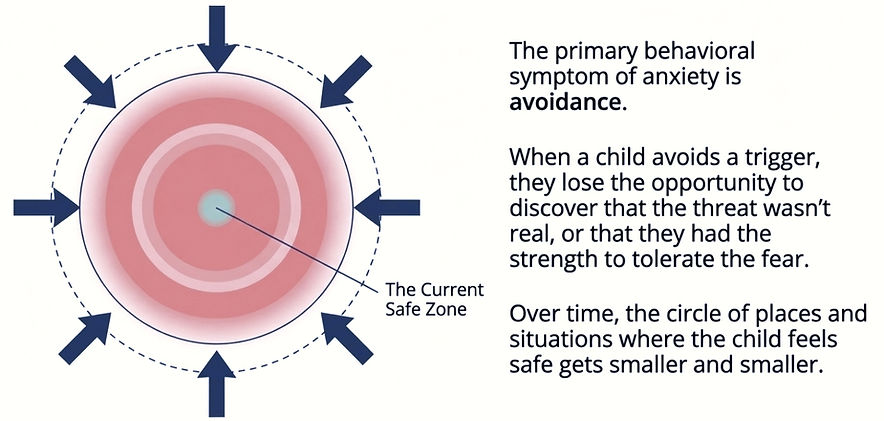
Over time, life starts to shrink around anxiety and spirals occur more frequently.
As a parent, it's only natural to respond to your child's suffering with assurances, accommodations, and comfort.
As odd as it sounds, your child's anxiety or OCD is counting on your protective and compassionate response to not only survive, but thrive.
Your Anxiety Homework Is Due
The Shrinking Safety Zone of Childhood Anxiety & OCD
Family Accommodation: The Trap Most Parents Get Pulled Into
When a child is frightened, panicked, or in an apparent state of suffering, a parent's natural response is to:
-
Offer repeated reassurances
-
Use logic and probabilities to explain why their fears are irrational
-
Eliminate triggers
-
Do whatever it takes to make them feel better as quickly as possible
In the moment, this approach feels like it's working.
Over time, it reinforces a crippling belief for the child: “I'm incapable of managing this on my own."
This pattern, often referred to as "family accommodation", gradually keeps anxiety and OCD going, even when everyone is trying their best to reduce it.

Modeling Courage and Uncertainty Acceptance
Helping a child with anxiety or OCD isn’t about eliminating fear. It's about helping them learn:
-
“I'm capable of having discomfort when OCD gets loud."
-
“I don’t need certainty to move forward.”
-
“I don’t have to fix or solve anything before I act.”
This is where evidence-based approaches like ERP, ACT, and SPACE come in.
With the help of an anxiety and OCD specialist, parents are taught how to draft and implement a family accommodation plan designed to help their child:
-
Face situations they’ve been avoiding
-
Reduce reliance on reassurance or rituals
-
Build confidence through experience, not explanation

Red Light: Things to Avoid
-
Offering reassurance (It's okay, nothing bad will happen.")
-
Removing them from uncomfortable situations
-
Debating evidence for and against their fears
-
Canceling plans or permitting school avoidance
Green Light: Strategies Worth Mastering
-
Validating without reassuring ("I can see this is really hard.")
-
Building confidence in their ability to overcome anxiety ("This isn't easy, and yet I know you have what it takes to let it pass.")
-
Sticking to the plan
-
Being their biggest cheerleader in overcoming anxiety and OCD
The Plan Isn't About Punishment or Being Less Supportive
One of the biggest misconceptions parents express about executing a family accommodation plan is that it means they have to be cold or dismissive toward their child.
It doesn’t.
It means shifting from protecting your child from anxiety to helping them discover and develop their ability to overcome anxiety on their own and without achieving certainty before moving forward.
Sticking to Your Family Accommodation Plan
A Resource Worth Checking Out
For parents looking to better understand this process, we often recommend Breaking Free of Child Anxiety and OCD by Eli Lebowitz. It provides a clear, compassionate explanation of how anxiety works and how parents can play a powerful role in helping their child move forward.
Final Thoughts...
You don't have to figure this out on your own.
We can help you design an accommodation plan that fits your family's needs and values.
At River City OCD Clinic, our clinicians specialize in ACT-enhanced ERP for all OCD subtypes and presentations, as well as anxiety and perfectionism. We offer individual therapy, group therapy, intensive outpatient treatment (IOP), and telehealth services throughout Kentucky and across participating PSYPACT states through Dr. Street Russell.
Related Articles
-
Why OCD Feels So Loud: Understanding the Trap of Compulsions, Reassurance, and Mental Rituals
-
When a Loved One Refuses OCD or Anxiety Treatment: How Families Can Help Without Losing Themselves
-
When Your Child Pushes Back: Helping Kids with OCD or Anxiety Without Giving In
-
How to Find an OCD Specialist: What to Look for in a Therapist
-
OCD Treatments to Avoid: What Doesn't Work—and What Can Make Symptoms Worse
-
Can Therapy Make OCD Worse? Signs Your Treatment May Be Reinforcing the Cycle